Sunday, August 28, 2011

Authenticity


the glowstick wench at Medieval Times


Two weekend ago, I visited Medieval Times with my boyfriend. The catalyst was a This American Life episode in which Ira Glass brought a medieval historian to the dinner and stunt show, and he loved it- much to everyone's surprise. In the historian's opinion, Medieval Times captured the spirit of the era, however imperfect the technical details may have been.

That's how I feel about living history, too- it's more important to create a feeling of history than recreate perfectly a past which most of us probably wouldn't enjoy visiting on the
weekends. Yet, when we visited Medieval Times, I found myself thinking some funny thoughts. When the main narrator... chancellor?... was speaking, warming up the crowd for the main show, I kept thinking "this is fine, but it's not what a real medieval fair is like". That's such a ludicrous concept- that some fake middle ages attractions are less authentic than other medieval attractions. The fact is they all have a huge element of fantasy, just in the the fact that they ask audiences to suspend disbelief in time travel. And yes, some medieval fairs are full on reenactments, where all clothing is made of period accurate fiber and the performers have mastered vernacular of the day. But ultimately, it's all a fantasy.


Thursday, August 25, 2011

Progress


I wish uploading images to blogger was a little easier. Here's an image of a work in progress. I think I may add the painted backdrop element to this painting. I'm really happy with the composition and I'm going to push the interaction between characters so that it reads like some of the great card-sharp paintings.

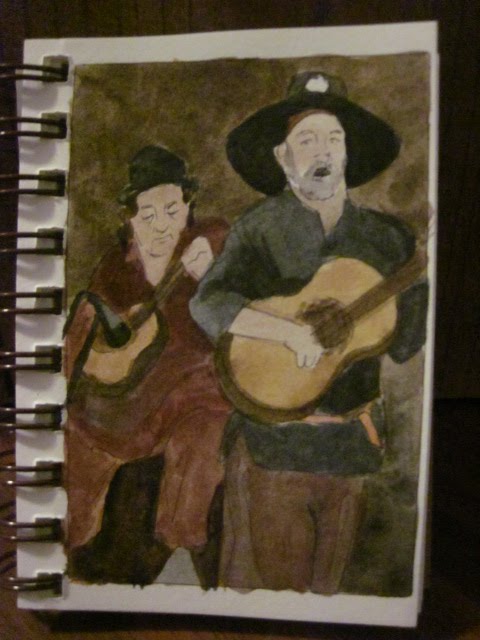
I'm putting aside the guitarist painting for the time being and I'm going to revisit the photo with the tuning devices which I previously discarded. I'm starting to think that would be an interesting moment to depict. I was concerned about making the performers look careless but in truth, tuning one's instrument is an act of care. I like the idea that a small, personal action precedes a public performance.

This weekend I'm going to print more photos and make more collages. I'm going to pay attention to what excites me about the photos, and focus less on what I think is 'viable' or 'appropriate' or 'meets expectations'.


Friday, July 29, 2011

How To Make A Painting

Haven't been blogging much lately because I haven't been doing much lately. But I've saved some pictures from the last week so I can do a nice image-heavy blog entry on my favorite question: How do you make a painting?


above: how to make a painting.

There are a lot of levels to this question so we'll tackle them the same way I tackle issues of painting: all at once, in no particular order, and with little efficacy. Essentially, you need an idea before you can make a painting, except when you're making the kind of painting whose idea takes shape through the construction process. You should start by making some sketches relating to your idea, unless you like the idea to come out of the sketch. Start by loosely sketching in areas. Start by making detailed tight compositional studies. Don't draw on your painting support. Make sketches on your painting support. Change everything so it doesn't resemble your sketch but perfectly embodies your concept, or decide that your concept has changed entirely yet the original form suits it.

You don't know what is going to happen. Start somewhere. You have to work but you owe it to yourself not to go insane. So start with what you can do.


I can do collages all day long. I gained an appreciation for the collage-- both as a working process and a fine art medium-- in Vicki Skinner's class at FAU. That was the first class to teach me to think critically about work as I am making it. It was also the first time I really got into the scissors, gluestick and xerox machine to work out compositions. That's how i made the image above- scaling and collaging original photos to fit the dimensions of my painting.


Once you've made your collage you can use it as a reference to make your painting. Even this process can be done a couple of ways. You can 'eyeball it', looking at the photo and matching it by sight. Or you can use some technology. The photo waaay up top is of my little projector (also known as my mom's projector... whatever). The photo immediately above is of a tracing made by enlarging and projecting my collage. It's faint and hard to see, but dead accurate.

Is it cheating to use tools and tech to make paintings? Evidence suggests the Old Masters didn't think so, or didn't care. Vermeer used a camera obscura to trace the drawings for his paintings. It's believed that's why they're so good! I am going to use another vintage painting trick on the above tracing: punching holes along the lines and rubbing charcoal into them to make a transfer.


This is how my first painting is coming. In real life it looks less... diseased.

Detail from above. Yeah, I know his eye is ... wrong...


Also! Sometimes I paint my nails lately. I don't know why but it makes me happy. The above have an orange and orange blossom design on a green background.


You have to do something. Do what you can. This is the moral of today's post and in keeping with this theme I am playing hooky from work. Where I come from, if you take a day off of work or school to go to the beach, you call it a "mental health day". Well, I had to take the day off to schedule and attend triage and counseling appointments. Shall we call it a "beach day"? Sounds like more fun.

Monday, July 18, 2011

Busyness

It's been a busy summer. I always feel like such a lazy person but even I have to objectively say I have been working pretty hard. I am learning about painting. I've applied for jobs and an internship. I've lost twenty pounds. I've been working as many hours as I can score at my nametag job. I've been writing a pretty cool blog ;) . I've been developing a studio practice and setting up a studio. I've even dabbled in cooking a bit.

Professor Broderick likes to talk about the importance of getting 'no's'. Get a 'no' every week. Get a thousand 'no's' a year. Apply to thirty grad schools, so no one 'no' will hurt too bad. I got a 'no' recently that left me pretty disappointed- I didn't make the curatorial assistant internship. But I have to take the prof's advice, and just be proud I put myself out there. Getting enough 'no's' means saying a lot of 'yeses'. Yes I will interview for this position. Yes I will take a qualification test for a new job. Yes I will take those extra hours. Yes I will spend fifteen dollars on a teeny tube of paint even though it makes me cringe. 'Yeses' keep you busy.

I took this weekend off to spend some time with my cousins. It was such a good weekend I couldn't even manage a little guilt about relaxing. And when I got home, I had some gifts waiting for me.

A professor had e-mailed me back. I got a reply from the fabulous Sally at alreadypretty.com. And I have three invitations to interview for new jobs.

Moral: get lots of no's. With them will come yeses.

Saturday, July 9, 2011

Scallop of St. James


This is a picture of Owain Phyfe, a musician I've posted photos and sketches of over the past few days.


This is Caravaggio's "Supper at Emmaus", the greatest baroque painting of all time, according to my history professor.

These images share a narrative detail-- the scallop shell worn as a symbol of St. James. The shell is visible on Owain's hat, and on the vest of the man at Christ's right in the Caravaggio. Wearing the scallop signals that one is following the Way of St. James to the saint's shrine in Spain. Owain tells this story during some of his performances at the Renaissance Festival, using the detail to ground himself in a time and place outside of the mundane world. It develops his persona, bringing depth to a character that some audiences may only encounter for a moment. Caravaggio uses the shell in a similar way, to give us a little extra information about a character in a painting. Presumably, in Caravaggio's time, the symbol of the shell would be more widely-known, easily recognizable to a viewer. In both cases, the tiny detail of a shell expands upon the world created by an artist through his work.

Friday, July 8, 2011

Sketchin'

I found these today while going through a sketchbook from last year. Gesture drawings of the minstrels that I'm painting. I guess this project has been in the works longer than I realized.
Here are some more thumbnails I've done to work out compositions. In the first couple I was trying to capture a really special performance from the Florida Renaissance festival. Every morning, immediately when the faire opened, before anyone started their first set, most of the musicians congregated at the Half Clef stage to play period music as a large ensemble. The energy was unlike anything else at the festival, and visually, having all those performers, costumes and instruments clustered together was fantastic.

I think this second one works better because there's a little more negative space and a diagonal is starting to form from top left to bottom right along the characters' heads. I may add more figures or hints of figures to really get that clustered feeling. The boy in the bottom right has ear gauges and a lip ring.
Some sketches of the minstrels I posted photos of yesterday. The one above is okay, but I am working on developing the one below more because I feel like it relates better to the Zurbarans I posted. These musicians frequently perform Spanish language songs, so I want to model them on a Spanish baroque artist.


I leave you with a line from my favorite of Owan and Charry's repertoire, an Argentinian ballad:

The sorrows of life and the little cows go down the same path. The cows belong to someone else; the sorrows are our own.

Thursday, July 7, 2011

Why I'm Not Using This Picture.

I wrote in my grant proposal that I planned to "capture moments of anachronism" when taking reference photos. So when I snapped this shot, I felt like it was perfect.


This shows musicians Owain Phyfe and Conrado Garcia using electronic tuners to tune their instruments. When I took this photo I felt like it really communicated the idea of the future as an intrusion on the performance of the past. But the more I live with this project, the less I like this photo. It makes the musicians, both enormously talented and among my favorite performers, look sloppy. And that's not the case. I probably took this photo before their set even started.
I don't want to belittle the artists, and I don't want to oversell the idea of anachronism.
In some way, I think the act of painting is anachronism enough.